
Bachelor's Degree in Renewable Energy – Electrical Engineering
Climate action is one of the most important issues facing us today. We train young people so that they can play an active role in protecting our environment. Thanks to their inexhaustibility and sustainability, renewable energies are our best option for the future.
The "Renewable Energies – Electrical Engineering" degree programme is an electrical engineering course specialising in electricity generation from renewable energy sources. It covers the core topics of feeding electricity from conventional and renewable energy sources into the grid, electrical energy storage, electrical energy transmission, grid control and energy economics, all of which play a crucial role in implementing the energy transition.
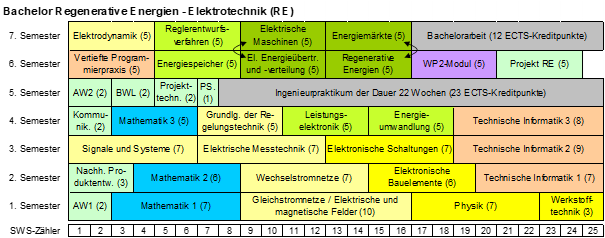
The first three semesters provide you with the necessary basic knowledge of mathematics and electrical engineering, which will then enable you to understand and apply the subject-specific content covered in the later semesters.
The two modules ‘Energy Conversion’ and ‘Electrical Machines’ provide specialist knowledge on electrical power generation. The two modules ‘Power Electronics’ and ‘Renewable Energies’ cover the design and specific operational behaviour of systems for utilising renewable energy sources (primarily wind and solar energy). In view of the increasingly fluctuating feed-in power from renewable energy sources, extensive measures are required for grid control and the storage of electrical energy. The knowledge required for this is provided by the two modules ‘Controller Design Methods’ and ‘Energy Storage’.
In future, there will be an increasing need for new approaches to long-distance electricity transmission and the associated grid stability criteria. The ‘Electrical Energy Transmission and Distribution’ module covers the fundamentals of electrical energy transmission, whilst the ‘Energy Markets’ module provides you with the basic knowledge of the key energy market processes in the liberalised electricity market.
On the ‘Renewable Energies – Electrical Engineering’ degree programme, in addition to specialising in renewable energies, you will also acquire the core skills that characterise an electrical engineer. These include, in particular, the abilities to analyse complex problems, to develop environmentally friendly and sustainable hardware- or software-based solutions, and to manage complex technical projects.
You are able to plan electricity supply networks and assess the operational behaviour of the equipment used within them, as well as the basic functioning of renewable generation units and their connection to the grid. You are familiar with the impact of decentralised generation systems on distribution networks and the relevant requirements set out in the grid connection conditions. You can design photovoltaic systems and assess existing ones. You understand the design of typical wind turbines for energy generation and can assess the key differences between current systems and their impact on control and management options during plant and grid operation.
In addition to specialist technical qualifications in Energy Technology and renewable energy, you will also acquire interdisciplinary skills that will enable you to collaborate with energy technology professionals whose career paths are based on a non-electrical engineering background. You will communicate and present the results of your projects in an interdisciplinary manner to a wider audience.
The renewable energy market offers plenty of job opportunities for engineers. According to a study by the Ministry of Economic Affairs, 230,000 new jobs related to renewable energy are set to be created by 2050.
As graduates of the “Renewable Energies – Energy Technology” degree programme, you will find interesting areas of work in the design and operational management of energy systems at engineering firms, energy suppliers, municipal utilities and network operators. However, research institutions, energy consultancy organisations and industry are also seeking Energy Technology engineers who can facilitate the increasing use of software solutions for the monitoring, control and regulation of energy systems.
Despite the boom in renewable energy, the traditional energy sector remains a strong economic sector. The modernisation of the power station fleet, the expansion of the grid and new business models – for example, those centred on energy efficiency or electric mobility – are not only creating positive employment effects with a growing demand for young talent and skilled workers, but also opening up prospects in new professions, such as regulatory manager, energy efficiency consultants, or energy traders. The “Renewable Energies – Electrical Engineering” degree programme is therefore structured in such a way that, as graduates, you will always be able to find employment in the conventional Energy Technology sector as well.

Further information


accreditation

