
Adaptive suction gripper for flexible gripping systems
Students are developing an adaptive gripping system for a robotic arm that automatically adjusts to different object sizes and enables safe transport.
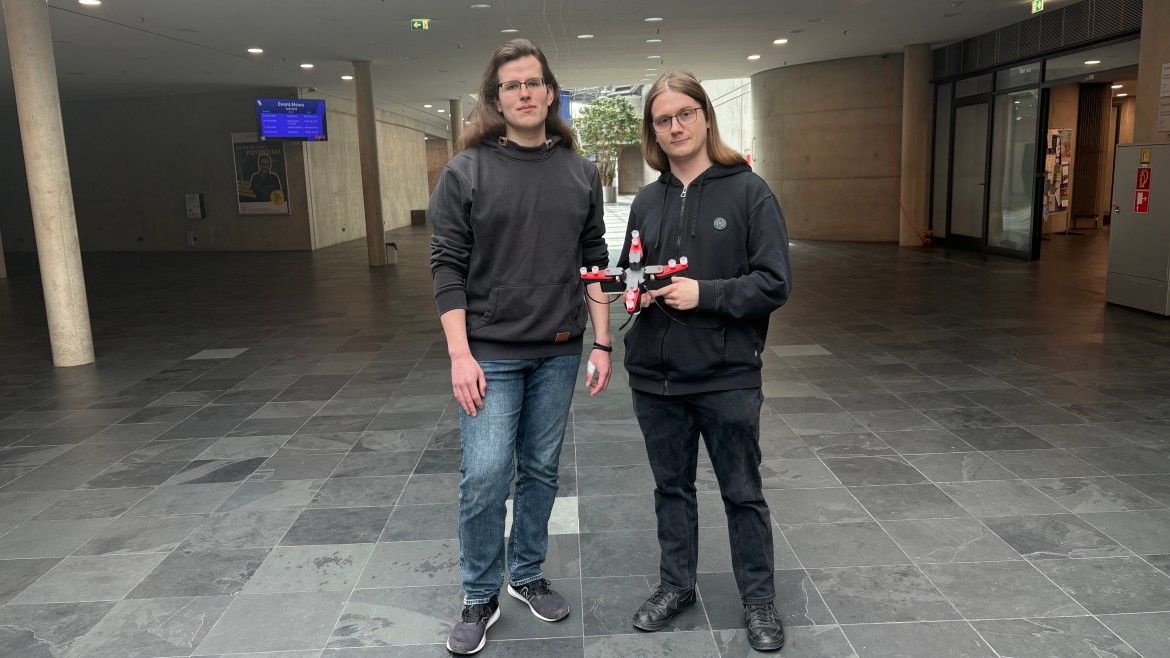
In automated packaging operations at logistics centres, small and large cartons alternate every second. Rigid suction grippers are only of limited use here: if the contact area is too small, they cannot grip large cartons securely; if it is too large, they can no longer grip small parcels reliably.
This is precisely where an educational project comes in, which was presented as part of the Projektvernissage at Hochschule München University of Applied Sciences.
In the Autonomous Systems course taught by Prof. Dr. Alfred Schöttl, Department of Electrical Engineering and Information Technology, Christopher Greska, Jan Siffling and Maximilian Leß, Bachelor’s students at the Department of Applied Sciences and Mechatronics, developed an adaptive suction gripper for a UR5 robotic arm. The aim of the project was to create a flexible gripping system that can automatically adapt to different object sizes whilst ensuring a secure grip – even during movement and acceleration.
The approach: a modular gripper with four servo-controlled arms that dynamically adjust their position, enabling them to securely grasp objects of varying sizes.
Adaptive gripping technology for varying requirements
The system is based on a simple yet effective principle: adjust, pick up, move, put down.
A key problem with conventional systems is torsional forces, which arise particularly during acceleration and can cause objects to become dislodged. At the same time, conventional suction grippers are limited by their fixed geometries and are only suitable for objects of a certain size.
The adaptive gripper developed by the three Bachelor’s students addresses these challenges by actively adapting its structure. Its variable width and depth make it possible to handle both small and large objects efficiently and securely.
Intelligent design and integrated systems
The gripper was manufactured entirely using 3D printing. Air channels were integrated directly into the structure to save space and keep the design compact.
Control is handled via ROS2: the software adjusts the angles of the gripper arms in real time whilst simultaneously monitoring safety-related parameters. The result is a system that is not only flexible but also operates reliably and safely.
Project presented at the Projektvernissage
The adaptive suction gripper for the UR5 robotic arm was unveiled at the Department of Electrical Engineering and Information Technology’ s Projektvernissage. The event gives students the opportunity to present their degree projects to the public and provides insights into topics within electrical engineering and information technology, as well as beyond.
The video for this project was produced by the students.
The next Projektvernissage will take place on 2 July 2026 from 10 am to 1 pm at Hochschule München (Lothstraße 64).